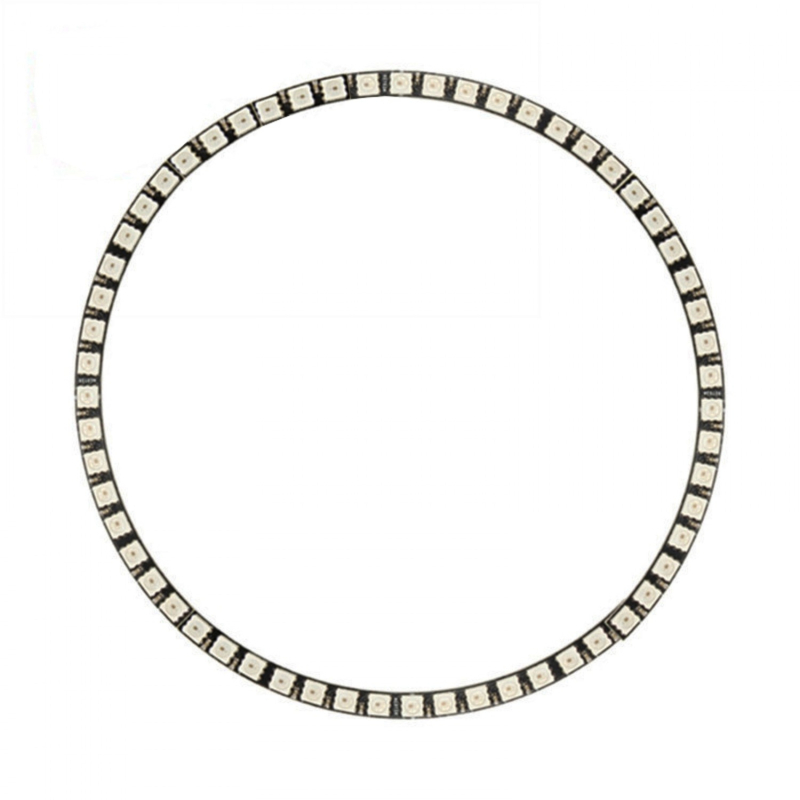
WS2812B Digital 5050 RGB LED Ring - 60 LEDs
Artikelnummer: 549900028-18A digital LED strip of which the color and brightness of each LED can be controlled separately. A lot of LEDs can be placed in sequence and all can be controlled with 1 pin of a microcontroller. Various platforms provide support for this LED by means of libraries, including Arduino and Raspberry Pi.
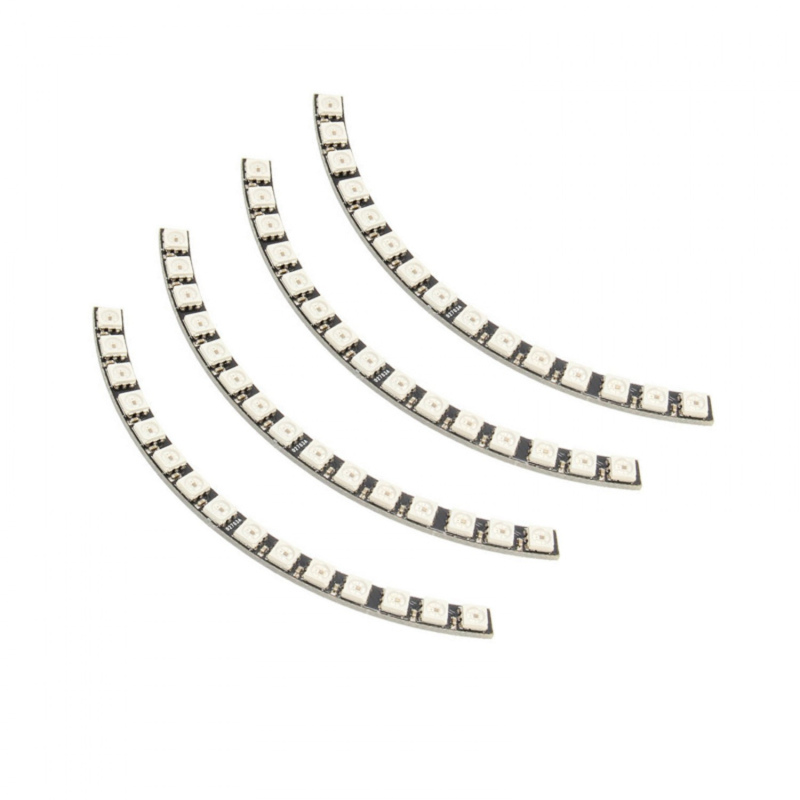
At the bottom of the PCB are solder pads for soldering wires. This ring consists of a set of four pieces that need to be soldered together to form a ring. The same solder pads can be used for this, the use of pin headers might be helpful (these are not included). Note: Make sure that the data pins at the beginning/end are not connected!
Specifications:
- Supply voltage: 5V DC
- Signal voltage: 5V
- Maximum current:
- Per LED: ~60mA
- Whole ring: ~3.6A
- LED chip: WS2812B
- Color: RGB
- Number of LEDs: 60
- Backup data line: No
- Inner diameter: 144.78mm
- Outside diameter: 157.48mm
Pinout:
- VCC: Supply voltage
- IN: Input of data signal (signal from an Arduino, RPi, or other WS2812(B) LED)
- OUT: Output of data signal (signal to another WS2812(B) LED or unconnected if it is the last LED)
- GND: Ground/min
Connecting the ring:
- Use a stable (CE approved*) power supply that can supply sufficient power (minimum is current value above per LED ring).
- Turn off the power before continuing.
- Connect the wires:
- First, connect the GND (ground/min) of the LED ring to the GND of the power supply (disconnect this last when disconnecting the ring).
- Connect the data (IN) wire via a 470Ω with the signal pin of the microcontroller (a level converter may be needed with 3.3V microcontrollers), or the data out (OUT) wire from another ring.
- Connect the VCC to the plus of the power supply.
- Connect the GND of the ring and power supply to the GND of the microcontroller.
- Put a large capacitor (1000μF 25V) between GND and VCC, close to the start of the ring.
- The power supply can now be turned on.
*There are many power supplies on the market that have a China Export ("fake" CE marking) or carry a CE marking, but are in reality not CE approved. We do not recommend using these, often cheap (Chinese), power supplies because they generally do not provide a stable voltage. A stable voltage is essential to make the LEDS work stable, and to prevent damaging them.
We recommend reading the following pages for more information: Powering Neopixels and Adafruit NeoPixel Überguide.
Check the tab "Downloads" for more information and/or downloads.
 €7,30 DHL Servicepunt